Touchstone on Campus
It is a program that connects the accomplished individuals who have navigated these systems successfully with students, researcher and faculty.
For engineering students in Pakistan to compete globally, their universities must institutionalize how global systems operate technologically, organizationally, and strategically.
The Touchstone on Campus Series is designed precisely for this purpose: to introduce students to individuals who serve as “touchstones” — reference points for standards, scale, and systems thinking.
February 19, 2026
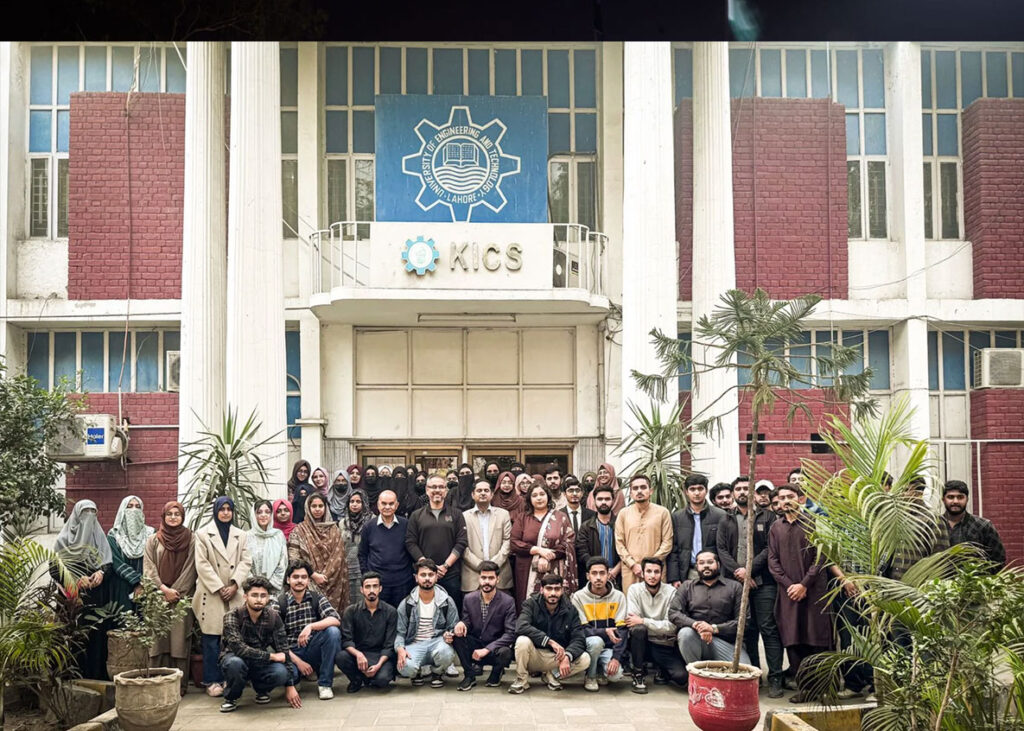
Touchstone on Campus” series was launched with an in-person event at UET, Lahore.
Engr Moazzam Chaudry (Product Management, Compute and AI/ML Infrastructure at Google and alumnus of UET, Lahore) returned to campus to engage students in a structured dialogue on Google Cloud and building globally competitive careers from Pakistan.
More than 50 students from Electrical Engineering, Computer Science, and AI programs participated in the session. The session was organised with the support of Mr. Niaz Siddique and attended by Dr. Muhammad Usman Ghani Khan, reflecting institutional alignment behind sustained engagement.
A central focus of the session was the evolution of artificial intelligence infrastructure. Students learnt about the transition from traditional GPU-centric compute environments to custom accelerators such as Tensor Processing Units (TPUs). The discussion extended beyond hardware mechanics to capabilities engineers must develop for the future.
Various success stories were discussed, including how companies such as FireEye and ImagineArt identified real-world constraints and translated them into scalable solutions. The underlying theme remained consistent: innovation is meaningful only when productised, deployed, and measured.
Students raised substantive questions on translating academic projects into deployable products, graduate education, global mobility and navigating readiness for competitive markets. The session was organized in a dialogue format rather than a lecture, allowing students to discuss the use of AI in their projects; get problem solving advice, and develop an understanding of the product management cycle.
Following the session, Ahmad Ahsan (Director ULEF based in Lahore) outlined ULEFUSA’s long-term vision to enable sustainable, structured engagement between alumni, industry leaders, and students, transforming visits into institutional continuity.
The conversation continued informally, allowing for deeper assessment of student priorities and ecosystem gaps. Such exchanges provide insights for future programming, mentorship frameworks, and capacity-building initiatives.
ULEFUSA affirms its commitment to enabling mentorship and ecosystem building by bridging global expertise with the UET student body, aligning academia and research with industry verticals, and creating pathways for networking and improving graduate competitiveness.
This engagement represents one step in a journey to build durable bridges between UET’s talent base and global leaders in innovation, converting exposure into capability, capability into competitiveness, and competitiveness into long-term institutional advancement.